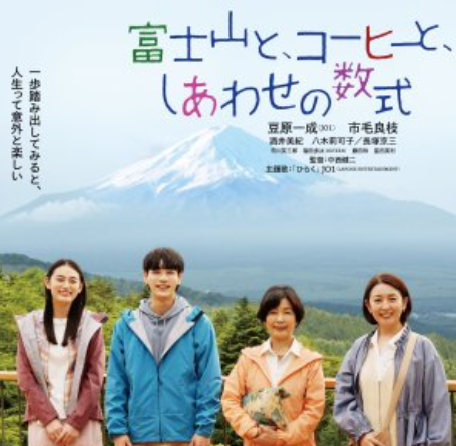
Sometimes we so got used to the term family drama in movies that if there is no ‘drama’, it is not a family drama. But then, from time to time you run into a family drama movie that is actually about the family not about the drama, and it still pulls you right into the middle of it. Mount Fuji, Coffee and the Formula for Happiness is one of them.
I didn’t know much about the movie prior to watching on the flight back from Japan to Hong Kong. I noticed it on the way to Japan, but I was preoccupied with Tokyo Taxi, so it was on my list to be the movie to watch on the way back. And I was not disappointed.
Just like a fine cup of coffee, you just need the right boil, the right beans and the right technique, you can get a nice and memorable cup of coffee without putting on a dramatic show.
Mount Fuji, Coffee and the Formula for Happiness is a movie about just family and how projection changes things when understanding was missing. Takuma, a university student who doesn’t enjoy his university life has a huge love for coffee. He enjoys his time as a barista instead of a student in the lecture hall. Not that he is not good, he just felt that he is not built for a standard post university office life, and that’s what he was not looking forward to. His mother, who is very successful thinks otherwise.
When the grandfather passed away, Takuma’s mother wanted him to spend time with the grandmother to keep her company while she is on a business trip. During the stay, Takuma discovered that his grandfather had enrolled his grandmother into an adult extension course at his university. And the story unfolds from there.
The so-called Formula for Happiness is a formula left in the diary of the grandfather on one of the dates, which the rest of the family was trying to solve.
What I like about Mount Fuji, Coffee and the Formula for Happiness is that they didn’t attempt to over-dramatise things. There was no unnecessary coincidence, there were no throwing things and large-scale shouting matches, and there were not physical fights. Yet as the story unfolds, you were drawn more and more into the characters, and you do care for them. I personally did not know most of the actors (I am out of touch with the current generation of Japanese stars and idols) but all of them delivered a very pleasant experience throughout the 1 hour 40 minutes run time. Mamehara Issei who played the lead Takuma was very boy next-door and comfortable to watch. Ichige Yoshie, who played the grandmother delivered a layered and deep performance just through a glance or a sip of her tea. Watching this movie reminds you sometimes we just need some good storytellers to tell a simple story, and they will make the story interesting.
Mount Fuji is an important character in the movie; hence it was in the title. And I am sure for the domestic audience, the emphasis on Mount Fuji and what it represents would even resonate with them more. I was lucky enough to have seen this movie after visiting Mount Fuji myself a few days ago, so all of a sudden, I totally got the message the movie was trying to deliver.
One of the takeaways I got from this movie was that, if your heart tells you something again and again, it might be good to just follow your heart. What other people think might be of good intentions, but they are never your heart. The other thing was that, after the movie, it got me back into hand poured coffee and I started doing it again, but probably not as professional as Takuma does.
Since Mount Fuji, Coffee and the Formula for Happiness is for local release, and probably made for the local audience, so there is a high chance that you might not be able to find it in your country. But if you manage to see it available, it is a good feel weekend afternoon movie.
It left a fuzzy warm feeling inside me after I finished it on the flight, so I hope it will do the same for you too.