First of all, if you are looking for a review that validates your view of needing a ‘historically accurate’ adaptation of the books, you have come to the wrong place. The Odyssey is a poem of 24 books (or novel of 24 chapters) that was largely written in Homeric Greek based on a lot of oral history story telling about the interactions between humans, gods and legendary beings. So, to look for a ‘historically accurate’ adaptation of the book is a ‘historically inaccurate’ view or approach to this movie.
Now back to the movie, to adapt a 24 books collection of a story into a 173-minute movie is no easy task. Sometimes I do feel that The Odyssey is more suitable as a TV series, as cutting out or changing anything to this much loved and one of the most influential pieces of literature could easily invite hate. Christopher Nolan has quite a hard task on his hands.
The Odyssey kept some of the classic literature form in some of its format - for example the use of rhythm and the emphasis on oral history telling through songs and poems, sometimes through a bard, are all paying respect to the original literature. However, Christopher Nolan did also try to modernise it with quick pace story telling and moving pieces of the story around, adding and cutting different bits to fit it into a modern day audio visual narrative. The end result? While it is easy to understand for the modern audience, certain elements were littered around to please literature lover as Easter eggs that, if you knew it you knew it. However, while I personally appreciate that, the hardcore literature purists may not appreciate Nolan’s efforts, as some might consider this version butchering the original text too much while paying lip services to please no one.
Nolan’s The Odyssey’s story was told in an intersecting non-linear way, which is quite ingenious as it echoes the way Penelope, Odysseus’ wife, way of delaying the completion of Laertes’ (Odysseus’s father) shroud – she weaved and unweaved everyday to stall the suitors. Just like Odysseus’s journey home – he thought he moved forward, only to find that his last journey was undone, either by the gods or by fate. The story in this version was also told through several character’s narration, including Odysseus himself, as compared in the original text, where only three parties told the story (also including Odysseus himself).
Despite being almost 3 hours, the story still needed to move quickly to avoid over explaining or stalling the rhythm, hence testing the audience’s patience. But when it comes to moments that required that gelling kind of tension, it was done very well, especially when the crew met Polyphemus, Poseidon’s cyclops son. Every moment just kept you on the edge of your seat. Wandering and homecoming are the two dominant themes of the original text, and this has not been lost, although certain characters and plotlines about the process of both were lost. Athena was reimagined in this adaptation as compared to her role in the original. While she did show up, the way she showed up and manifested were different. Zeus was largely absent apart from some name drops here and there. There were other characters who were completely absent from the original. So, if you so happen to want to see those characters you will without a doubt be disappointed. Sinon, was a character that was not originated in the original Homer version but borrowed from Aeneid to enrich the story arch of Antinous, one of the major suitors vying for Penelope’s hand. While the addition of Sinon did help flashing out the story and tension among Antinous, Telemachus and Odysseus, I have a feeling that a lot of purists will not like it. Elliot Page did a great job of the character, but I felt that it would be an uphill battle for purists to like the addition.
Christopher Nolan managed to assemble a great cast for this epic retelling of the story, with Matt Damon as Odysseus, Tom Holland as Telemachus, Anne Hathway as Penelope, Robert Patinson as Antinous, Lupita Nyong’o as Helen and Clytemnestra, Samantha Morton as Circe, John Leguizamo as Eumaeus, Zendaya as Athena, Charlize Theron as Calypso, Jon Bernthal as Menelaus etc. They all delivered very outstanding performances, but one thing I just find it interesting is that in the movie, the women were earthlier looking than the men. So, the women (god or human) look convincing in terms of the era the character they are playing but the men, no matter how they roughed their looks up, still look like modern pretty boys to me. Maybe that’s the male aesthetic in that era of fantasy stories? I don’t know.
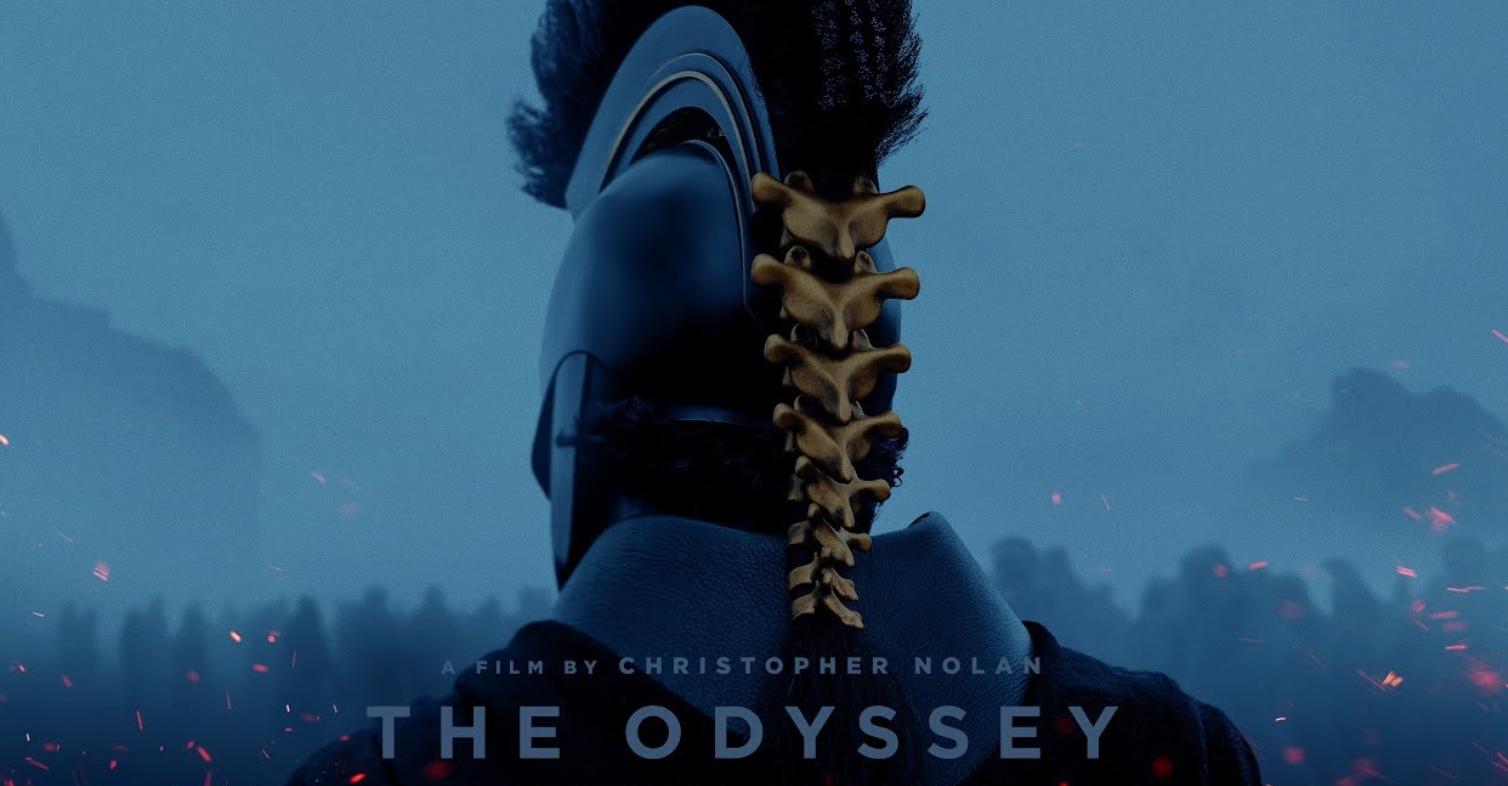
The aesthetics of the film was extremely rustic and continues to embrace Nolan’s signature tactile approach to production art. From costumes to framing of the real environment in every scene, you can see a lot of attention and details were employed. Sometimes the physicality of real landscapes is hard to be replaced. I am just surprised how many real environments Nolan and his team were able to scout and find around the globe for the old epic story. While these natural environments did pose challenges I think at the end of the day all that hard work paid off.
In the music department, there were epic scores mixed with raw material sound to bring it back to earth. There were a lot of ‘bronzy’ sounding track, not akin to modern brass, but just really, well, ‘bronzy’ sounding, which I felt suits the movie a lot. Personally, I found the plucking sound of the bow string was a bit too ‘nice sounding’ but maybe that’s a choice that I did not understand. There was a bit of vocal chants here and there, but they were not as prominent as one would expect, which is fine with me, as it will take away the rawness of movie if over applied. Overall, the sound and music were earthly with a few of aethereal tones when it involves the gods.
The Odyssey is a fantasy story, so it will have special effects. But what I was surprised was that there were no grand OMG kind of special effects. Special effects were applied only when the part of the story called for. And even when applied, do not expect something akin to Star Wars or the modern superhero movies. There were no flashes of bright light or anything like that. Just down to earth godly behaviours and tricks (hopefully that makes sense after you saw the movie).
All in all, I enjoyed this adaptation of The Odyssey. Despite my occasional questioning of choice of narrative, it was a well made movie that has a lot of heart and introspections of who we are, and how we can continue this journey. As I said, if you went in looking for a faithful adaptation of the poems, you will be disappointed. If you went in looking for a special effect spectacle, you will also be disappointed. But if you are looking for a movie adaptation of a piece of influential literature and interested in finding out how the story and the characters are still relevant to our modern world in a deeper sedimentary manner, you will not be disappointed and may even be able to find some timely answers to your timely questions.
Christopher Nolan’s The Odyssey is now in the cinemas.